I wasn’t sure what opening this was but with most of the center pawns gone, I guessed a double KP opening, I later discovered this is a position from the Danish Gambit. Black’s Q is attacked and must move, since there are no tactical tricks available. Capturing the White d-pawn with the Q is a blunder met by 10. Bxc6+ and Black can resign (this actually happened in the game Levy-Martinez Vaca, 1972!). Following the principle of moving a piece to the most forward square possible, the move 9 …Qc4 comes to mind, both preventing White from castling and threatening 10 …Bxc3+ next move. I looked up the position and found the game Marshall-Capablanca (among many others) and in that game Capablanca played 9…Qc4. This seems to be the most common move for Black in the position.
I charge US$ 25 per hour, US$ 100 for 5 hours or US$ 200 for 10 hours, if one purchases them in advance.
Lessons happen on Playchess & ChessRex.com. I use Teams and Google Meet.
Teaching experience – 26 years. Students’ level ranges from beginners to players with 2400 ELO (IMs as well).
My mom Nadezhda Fokin (Israeli Women’s Champion, 3rd board in 1992 Chess Olympiad, Soviet Women’s Master) charges US$ 20 for 1 hour (payments via my PayPal e-mail – [email protected]).
Game analysis with verbal comments and suggestions on what to improve and how
Easy improvement – detailed analysis of your games done by an International Master. I charge US$ 10 per game or US$ 35 for 5 games. Analysis can be sent by pgn, html, cbv formats.
Just US$ 5 for monthly subscription to weekly e-mails with middlegame/endgame material
Send US$ 5 to [email protected] on Paypal and get 10 game fragments on middlegame/endgame every week. Studying these themes helps to find plans, ideas, build strategies 15-35 moves into the game. It is very important to study these themes as the middlegame is where most players get into time pressure or just cannot find a plan. Material can be sent in pgn and cbv formats.
Don’t know how to study chess or what to study to improve?
Check out the study material pages or e-mail me at [email protected].
Just US$ 5 for monthly subscription to fresh opening ideas & updated theoretical lines sent weekly by e-mail!
Want to learn to play the middlegame or endgame well?
I have a collection of over 40 thousand examples. It is very important to study these themes as the middlegame is where most players get into time pressure or just cannot find a plan. Prices: each annotated example costs 20 cents, so 10 examples cost 2 euros, etc. Send payment to [email protected] on PayPal to get the examples by e-mail in cbv, pgn, html formats.
Special price for middlegame books with very interesting verbal explanations
I have a collection of over 40 thousand examples. It is very important to study these themes as the middlegame is where most players get into time pressure or just cannot find a plan. Prices: each annotated example costs 20 cents, so 10 examples cost 2 euros, etc. Send payment to [email protected] on PayPal to get the examples by e-mail in cbv, pgn, html formats.
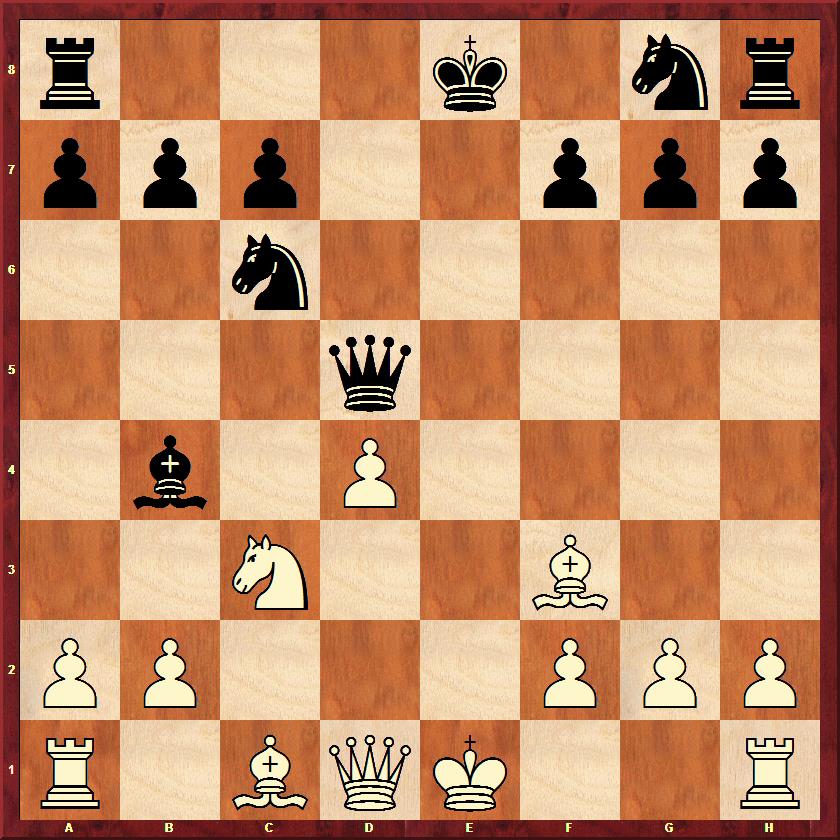
I wasn’t sure what opening this was but with most of the center pawns gone, I guessed a double KP opening, I later discovered this is a position from the Danish Gambit. Black’s Q is attacked and must move, since there are no tactical tricks available. Capturing the White d-pawn with the Q is a blunder met by 10. Bxc6+ and Black can resign (this actually happened in the game Levy-Martinez Vaca, 1972!). Following the principle of moving a piece to the most forward square possible, the move 9 …Qc4 comes to mind, both preventing White from castling and threatening 10 …Bxc3+ next move. I looked up the position and found the game Marshall-Capablanca (among many others) and in that game Capablanca played 9…Qc4. This seems to be the most common move for Black in the position.
I really like this idea, to help analyze positions that are not purely tactical. Thank you!
Welcome 🙂 And well done on your thoughts 🙂 .